
Top Down Bottom Up Shades in Kansas City: Privacy Meets Light
Lower the shade from the top, keep the bottom covered, and stop choosing between daylight and privacy in your Kansas City home.
Look down almost any street in the metro, and you will see shades stopped halfway up. That position covers the top of the glass, where the good daylight is, and leaves the bottom open, where people can see in. It is backwards. Top-down/bottom-up shades lower from the top instead. Daylight over your head, privacy below, same window. If you are still weighing this against the alternatives, we compare the options in balancing privacy and natural light and in our rundown of the best window treatments for privacy.
 Duette® Honeycomb Shades
 Duette® Honeycomb Shades
 Vignette® Modern Roman Shades
 Applause® Honeycomb Shades
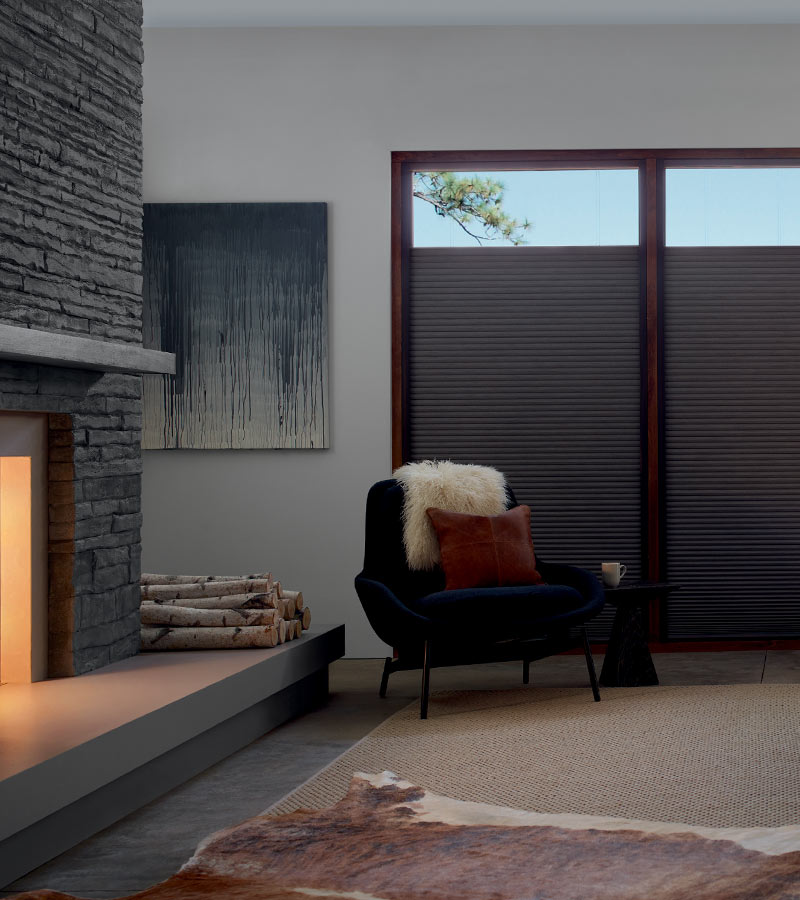 Duette® Honeycomb Shades
 Vignette® Modern Roman Shades
 Vignette® Modern Roman Shades
 Vignette® Modern Roman Shades
 Alustra Roman Shades
 Duette® Honeycomb Shades
What Makes Top Down Bottom Up Shades Different From a Standard Shade
A standard shade pulls up from the bottom, like every blind you have ever operated. A top-down/bottom-up shade still does that. It just adds a second rail near the top that you can pull down on its own. One extra rail, one extra control, and that is the whole mechanical difference.
People assume it snaps to a halfway point. It does not.
Drop that top rail three inches, six inches, a foot, halfway down the glass, or all the way to the sill if you want the window fully open from the top down.
You are also not locked into using it. Plenty of our customers run these like a normal shade and only reach for the top rail when they need it.
Top Down Bottom Up Cellular Shades: The Style We Install Most
Ask what people actually choose, and the answer is honeycomb. Top-down/bottom-up cellular shades are the version we sell most, because the two features stack. The honeycomb traps air in pockets, giving cellular shades the highest R-values of any interior window covering.
Lower the top rail and light filters in across the ceiling while the rest of the window stays covered by insulating fabric. Daylight without losing the thermal barrier, which counts in a metro that swings from 95-degree Julys to 15-degree Januarys.
We build top-down/bottom-up honeycomb shades on:
- Duette® Honeycomb Shades for the widest fabric and cell-size range, including the Architella® triple-cell constructions
- Applause® Honeycomb Shades when you want the honeycomb performance at a friendlier price point
If energy performance is the main driver for you, our energy-efficient window treatments page goes deeper on fabric and cell selection, and we have separate guides on keeping heat out in summer and keeping heat in during winter.
Top Down Bottom Up Roman Shades When You Want a Softer Look
Honeycomb is the practical pick. Roman is the pretty one.
Roman shades bring fabric texture and pattern that a cellular shade cannot match, and they read as a designer treatment rather than a functional one. The top-down/bottom-up feature works on them just as well.
Here is a detail most people do not think about. A Roman shade does not have to stack tidily at the top of the window when it is open. You can leave it hanging in the glass so the pleats are visible, which looks genuinely good, and then lower it from the top for light. You get the elegance and the function at the same time instead of choosing.
We offer this on:
- Vignette® Modern Roman Shades for clean, uniform folds with no visible cords or rear fabric
- Custom Roman Shades when you want your own fabric and a specific fold style
- Alustra® Woven Textures® Roman Shades for a natural, open weave
- Provenance® Woven Woods for grasses, reeds, and bamboo
Where These Shades Actually Earn Their Keep
We have installed enough of these to know where they get used every single day versus where they sit unused.
Bedrooms. This is the strongest case. You want to wake up and get dressed in natural light, and you obviously do not want to do that in front of an uncovered window. Drop the shade from the top, let the light come over, keep the bottom covered. If you also need full darkness for sleeping, we can pair this with room darkening or blackout bedroom fabrics.
Bathrooms. Almost every bathroom window is a privacy window that also happens to be the only natural light source in the room. Top-down/bottom-up solves it cleanly, and you stop relying on the vanity lights during the day. More on bathroom privacy window treatments.
Kitchens and eating areas. Breakfast nooks and kitchen sink windows tend to sit low and face a neighbor or a driveway. Lowering from the top gets light onto the counter without putting your kitchen on display. More on kitchen window treatments.
Street-facing front rooms. If you are on a corner lot or a busy through street in Overland Park or Brookside, this is the feature that lets you keep the front curtains open in spirit without actually being exposed. See our notes on street-facing window solutions.
Home offices. Video calls with a bright window behind you are a problem. Dropping the top rail and keeping the bottom closed cuts the backlight and the glare without darkening the room. That goes double in a lower level, where the room has no daylight to spare. See basement window treatments.
Cordless and Motorized Top Down Bottom Up Shades
You have three ways to operate these.
- Cordless. Two small handles, one on each rail. You push the bottom rail up and pull the top rail down by hand. This is the default on most of what we sell, and it keeps the window clean and child-safe. See our cordless and child-safe options.
- Continuous cord loop. A tensioned loop anchored to the wall or frame. Useful on tall or heavy shades where a cordless spring would be fighting a lot of weight.
- Motorized. Motorized top-down/bottom-up shades run on Hunter Douglas PowerView® automation, which drives both rails independently from a remote, an app, or a schedule. This is the option to look at if the window is over a stairwell, above a kitchen sink, behind furniture, or eight feet up. It is also the only practical way to run these across a whole floor of windows without walking to each one twice a day. Our full motorized and smart shade systems page covers the automation side.
One honest note on motorization: it is a meaningful price step, usually a few hundred dollars per window. Worth it on hard-to-reach glass. Less compelling on a window you walk past every morning anyway.
Why Kansas City Homeowners Buy Their Top Down Bottom Up Window Shades From Us
- You can put your hands on one before you buy. We have working top-down/bottom-up window shades mounted in our Overland Park, Shawnee, and Lee’s Summit showrooms. Pull the rails yourself. The difference between reading about a dual-rail lift and operating one is significant, and it changes what people order.
- Measurement precision matters more on these than on a standard shade. Because the shade adjusts from both ends, a fraction of an inch off can cause binding or leave a light gap at the top or bottom. We measure every opening ourselves rather than working from numbers a homeowner sends in.
- We fix what we sell. Two rails means slightly more hardware than a basic shade. Ten years from now, if a cord lock needs adjustment, you call us, and we come out. Our window covering service team handles repairs on shades we installed, which is not something you get from an online order.
- We are a Hunter Douglas dealer, not a reseller. That means access to the full fabric library, the specialty shapes, and the current lift systems, plus factory warranty support handled through us instead of a call center.
- Family-owned since 1995, four locations, 1,500-plus Google reviews at 4.9 stars. We have been doing windows in this metro for more than 30 years, now under second-generation ownership, and we are not hard to find if something goes wrong.
- We will talk you out of it when it does not fit. If your window is 14 inches tall, the top-down feature has nowhere useful to go. We will tell you that instead of selling you the upgrade.
How We Build Your Custom Top Down Bottom Up Shades
1
Free in-home consultation
We come to you because we need to see the window. How tall is the glass, what sits at eye level from the sidewalk, and is this a bedroom at night or a bathroom around the clock? If the window is too short for a top rail to go anywhere useful, we will say so. Book a free consultation.
2
Measure and quote
We bring samples so you can hold fabric against your own window and see what it does in your light. Then we settle the shade (honeycomb, Roman, or woven wood) and the lift (cordless, corded loop, or motorized). Every opening is measured to the sixteenth, since a shade that adjusts from both ends has twice as many chances to bind. Quote and lead time come before anything is ordered.
3
Professional installation
Privacy lives and dies on fit. A quarter-inch of light gap at the edge is a quarter-inch of sightline, and that is doubly true here, where the floating rail has to travel the full height of the window without catching. Our own installation team handles every job and answers to the person who measured it.
4
Final walkthrough
Before we leave, we set both rails and show you the range: three inches, six inches, a foot, halfway, all the way down. Most people find their everyday position in the first week and rarely move it again. If anything ever needs adjusting, you call us directly, and our service team comes back out.
What Top Down Bottom Up Shades Cost
Straight answer: it is not an expensive feature. Treat it as an upgrade on a shade you were already buying, not a separate purchase. Industry-wide, a dual-rail lift runs 20 to 40 percent above a standard bottom-up lift on the same shade, which on most windows lands around $50 to $150 extra depending on product line, fabric, and size.
The catch is that you cannot add it later. Once a shade is built without the second rail, retrofitting is not practical, which is why we bring it up before you order rather than after. If you are updating window treatments across the whole house, decide which openings get the second rail while you are still choosing fabrics rather than after the quote is signed.
Ask us about current promotions and financing at your consultation.
Frequently Asked Questions
Are top-down/bottom-up shades worth the extra cost?
For most homeowners, yes, because the upgrade cost is small relative to the shade itself. They earn their keep fastest on ground-floor windows, bathrooms, and bedrooms where you need privacy and daylight at the same time. On a small upstairs window nobody can see into, the value drops off.
Do top-down/bottom-up shades have cords?
Most of ours are cordless, operated by small handles on each rail. There are internal support cords hidden inside every top-down/bottom-up shade that hold the floating rail in position, but they stay concealed during normal use. If child safety is a priority, ask about our cordless and child-safe options.
Can you add top-down/bottom-up to any shade?
No, only to certain styles. It works on cellular, honeycomb, pleated, Roman, and woven wood shades. It is not available on roller shades, solar shades, blinds, or shutters because those constructions have no way to support a floating rail.
Do top down bottom up shades block light completely?
That depends on the fabric, not the lift. Choose a blackout or room-darkening opacity, and the covered portion of the window will block all light essentially. Keep in mind that when the top rail is lowered, that upper section is open glass, so full darkness requires the shade fully closed. If you want light filtering and room darkening available on the same window, dual shades put two fabrics on one headrail and handle that better than a single top-down shade will.
Are top down bottom up shades good for bedrooms?
They are one of the best bedroom applications there is. You get morning light coming in over the top while the lower half of the window keeps you covered while you are getting dressed. Pair it with a room-darkening fabric, and you get sleep-quality darkness at night from the same shade.
Can top-down/bottom-up shades be motorized?
Yes. Hunter Douglas PowerView® automation runs both rails independently on Duette® and Applause® honeycomb shades, controlled by remote, app, or automated schedule. It is the practical choice for tall, high, or hard-to-reach windows.
How do you clean them?
Dust regularly with a vacuum on low suction using a soft brush attachment, working across the fabric rather than up and down. For honeycomb shades, avoid soaking the fabric, since water can collapse the cell structure. Spot clean with a barely damp cloth if needed.
Do they work on bay windows or unusually shaped windows?
Bay windows work well, since each unit is built to its own opening. Specialty shapes like arches and angled windows are more limited, because a floating rail needs a consistent width to travel. We can look at your specific opening and tell you what is possible, and our bay window, angled and arched pages cover the alternatives.
How long do they take to get?
Most orders run two to four weeks from your consultation to installation, depending on the product line and fabric. Custom fabrics and motorized systems can take longer. We give you a firm timeline before you sign anything.
Come See Them Work
Reading about a dual-rail lift only gets you so far. Stop by our showroom in Overland Park, Shawnee, or Lee’s Summit, or let us bring the samples to you and see how the light actually falls in your own rooms. We also serve Kansas City North and Liberty.
Call us or schedule your free in-home consultation, and we will show you exactly what top-down/bottom-up shades will do for your windows.