What actually works in a Kansas City dining room, judged from the head of the table and from the curb.
Most dining room window treatments get picked for how they look from the head of the table. That is only half the job. In the Kansas City homes we work in, the dining room usually sits at the front of the house, which means whatever goes on those windows is also visible from the street, the driveway, and every neighbor walking past your yard. Get that right, and the entire front of your home reads as intentional. Get it wrong, and one window looks like the odd one out for the next fifteen years.
Why Dining Room Window Treatments Start at the Curb
Walk out to your mailbox and look back at your house. If your dining room, living room, and front bedroom windows sit in the same sightline, they need to relate to each other. Not identical. Just chosen by the same person on the same day.
This is the step homeowners skip most often, and it is why we bring up the exterior before opening a fabric book. Once you know what the front of the house needs, the interior choices get easier.
What we look at:
- What is on the neighboring front windows right now, and whether it is staying
- Whether the backing color of a shade will match the other white backings across the front
- Whether hardware, valances, or shutter frames will line up visually from the sidewalk
- Whether the dining room is genuinely visible from the street, or tucked behind a porch or landscaping
If your front windows are already a mismatched collection, this is the moment to fix it. We handle that on our street-facing window solutions page in more depth.
Plantation Shutters: The Dining Room Window Coverings We Install Most
When a homeowner wants consistency across the whole front of the house, we do a lot of shutters. They read the same from the outside on every window, whatever the size or shape, so you get one uniform look across the entire elevation.
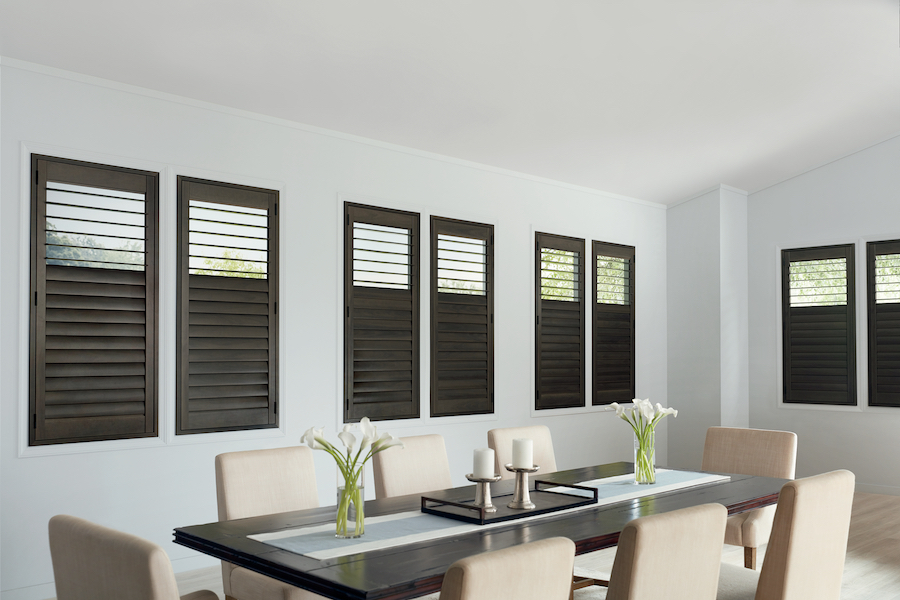
Inside the dining room, the feature that earns its keep is the divider rail, the horizontal bar that splits the panel into upper and lower sections that operate independently.
Here is why that matters at dinner. Close the bottom half for privacy at eye level so people on the sidewalk are not watching your table, and leave the top half open so daylight still pours in overhead. Privacy and light at the same time, which is the exact problem a dining room presents.
We carry three shutter lines through our plantation shutter collection:
- Heritance Hardwood for real wood grain and stained finishes
- NewStyle Hybrid for a painted look with more durability than solid wood
- Palm Beach PolySatin for a crisp white that will not warp, crack, or yellow
We recommend the same approach in the room next door, which you can see on our kitchen window coverings guide.
Shutters Feel Too Plain? Add Drapery Panels
We hear this constantly: “Shutters are nice, but this is a dining room. I want it to feel more formal.”
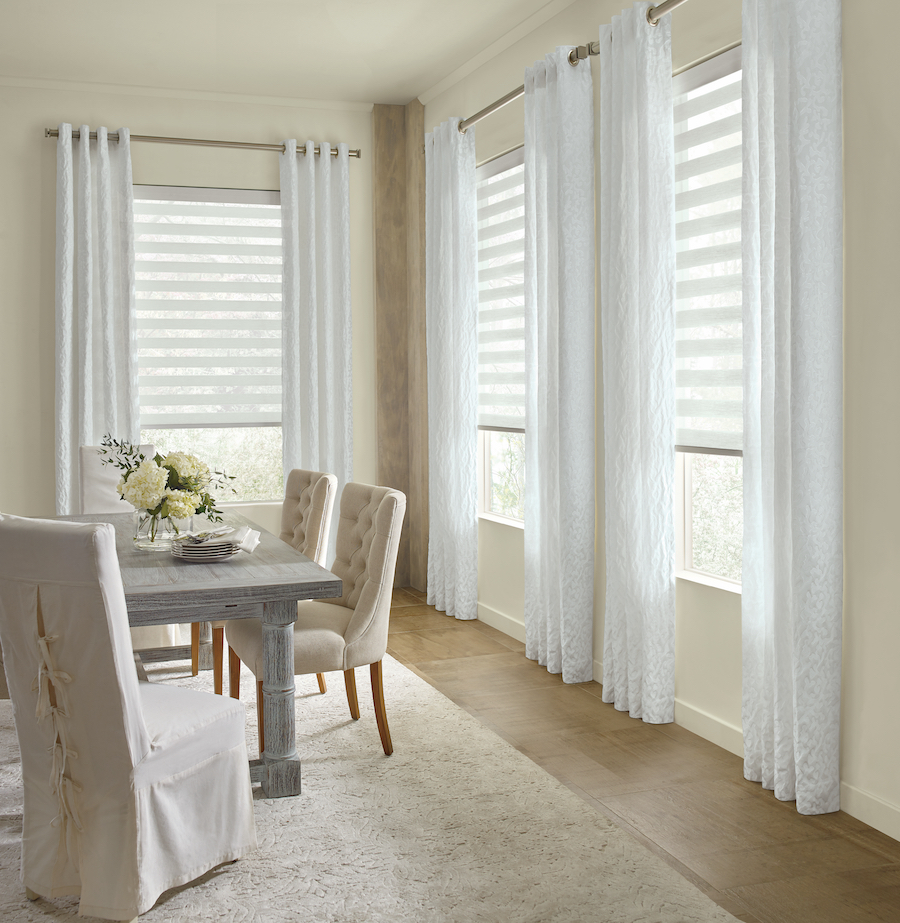
It is a valid concern. Shutters on their own are architectural, and in a room with a chandelier and a full dining set, some homeowners want more. The fix is not to drop the shutters. It is to flank them with custom drapery panels.
Stationary panels bring in what shutters cannot: fabric, pattern, color, and weight. Same shutter, now reading as the structured base layer of a designed window instead of a hardware choice.
The hardware matters too. Rods and finials are jewelry for the window, and crystal finials have gotten very popular lately. In a dining room with a chandelier or polished metal, they tie the room together.
This combination is one of the most common things we install in Kansas City dining rooms. See more on our layered window treatments page, or explore the fabric side through our custom window treatments collection.
Custom Roman Shades and the Detail Most Companies Skip
For a formal look driven entirely by fabric, custom Roman shades are the answer. You pick the fabric, fold style, trim, and lining.
One catch most homeowners do not hear about until it is installed: traditional Romans run lift cords down the back of the fabric. Invisible from inside, visible from outside in the right light. On a front-facing window beside others with clean white backings, that shade reads as the odd one out. If the room faces the backyard, it does not matter.
When it does, we go to the Hunter Douglas Vignette Modern Roman Shade. Same soft folds and fabric depth, operating system hidden in the headrail, and a clean white back that matches your other Hunter Douglas shades across the front.
Traditional Roman vs. Vignette, in plain terms:
| Custom Roman Shades | Vignette Modern Roman | |
|---|---|---|
| Fabric selection | Widest possible range | Curated Hunter Douglas line |
| Cords behind fabric | Yes | No |
| Exterior appearance | Varies by fabric and lining | Consistent white backing |
| Best for | Back-facing or private windows | Front-facing windows in a sightline |
When Your Dining Room Is Not Really a Dining Room
In 2026, a formal dining room often is not used for formal dining anymore.
We walk into these rooms and find home offices with a monitor where the buffet used to be, playrooms with a rug and a toy bin, craft rooms, and homework stations. The chandelier and tray ceiling are still there. The room is doing a different job.
That changes the brief. You do not need a formal treatment in a room that is no longer formal, and you should not pay for one. If the furniture and finishes are changing too, here’s how we think about updating window treatments when your decor changes.
Casual dining room window shades that work in these rooms:
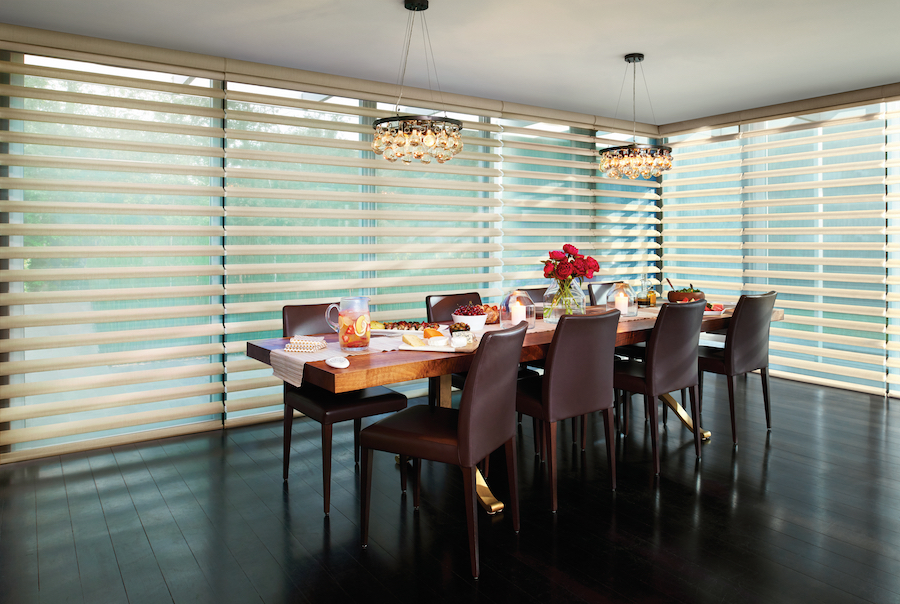
- Designer Roller Shades are the workhorse here. Cordless operation, clean modern lines, hundreds of fabrics from sheer to full room darkening, and they disappear into the headrail when raised.
- Sonnette Cellular Roller Shades give you the same soft rolled look with a curved cellular construction that blocks heat. If the room is now an office and the afternoon sun is cooking your desk, this is the one.
- Cordless blinds in wood or alternative wood give you both motions: tilt the slats for light angle, or raise the whole blind for a clear view.
- Shutters still work perfectly here too. They are formal enough for dining and casual enough for a playroom, which is part of why they are so consistently requested.
Every option above is available cordless, which matters if the room now belongs to a toddler or a dog. There are no operating cords to reach, pull, or wrap. That is the entire premise of our cordless and child safe category, covered further on our child-safe window treatments page.
The Best Blinds for Dining Room Windows
When homeowners ask us directly about the best blinds for dining room windows, the honest answer is that it depends on one thing: how much you want to adjust them.
Blinds give you tilt control, which no shade does. On a dining room window that catches low morning or late afternoon sun, being able to angle the slats and redirect the glare off the table is genuinely useful during a meal.
Where each one lands:
- Parkland Wood Blinds bring real warmth and grain. Best in dining rooms with wood furniture, wood floors, or a traditional palette.
- EverWood Alternative Wood Blinds look like wood and hold up to humidity and temperature swings. A better call for a room next to a kitchen or a west-facing wall of glass.
- Aluminum Blinds suit a modern or minimal dining room and are the lightest-profile option on the list.
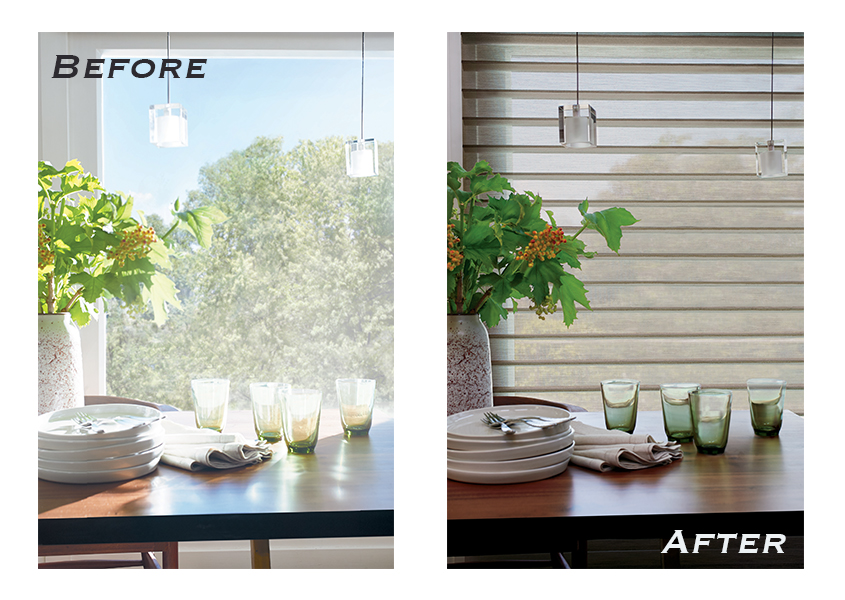
If the dining room windows are large, tall, or hard to reach behind a table, add motorized operation and adjust the whole room from your phone or a wall remote.
Sometimes the Right Answer Is Nothing on the Glass
We make this recommendation more often than you would expect.
If your dining room faces north or looks out over trees, a greenbelt, or a private backyard, you may not have a privacy or direct sun problem. You have a view. Covering it with a shade you will never lower is spending money to make the room worse.
In those rooms, we leave the glass alone and use drapery panels only. Mounted wide and high on a substantial rod with real finials, panels picture-frame the window and add the color, pattern, and softness the room needs. They pull your eye toward the view instead of blocking it, and they cost less than a full window covering with drapery layered on top.
Why Kansas City Homeowners Work With One Stop Decorating
We have been doing this in the Kansas City metro for over 30 years, out of four locations, as a family-owned business with more than 1,500 Google reviews and a 4.9 rating.
What that actually gets you:
- We look at your house, not just your window. The front-elevation conversation at the top of this page is standard for us. It is not standard everywhere.
- We know what these houses do. South- and west-facing Johnson County dining rooms bake in July. Big single-pane windows in older Brookside and Prairie Village homes leak heat in January. We recommend accordingly, which is why energy-efficient window treatments come up so often in this room.
- Full Hunter Douglas line, plus custom workroom fabrication. We are not limited to one catalog. If the answer is a custom Roman in your fabric, we make it. If it is a Vignette, we order it.
- Real showrooms you can walk into. Overland Park, Shawnee, Lee’s Summit, and Kansas City North. Touch the fabric and operate the shade before you buy it.
- We are here after the install. Our own team handles professional installation, and our service department handles anything that comes up later.
How the Process Works
1. Free in-home consultation.
We come to you because we need to see the room and the elevation it sits on. Is the dining room at the front of the house? What is already on the windows beside it? And is this room still hosting dinners, or has it turned into an office? Those answers set the direction before we open a fabric book. Book a free consultation.
2. Measure and quote.
We bring samples so you can hold fabric against your own window and see what it does in your light at that hour, not under showroom bulbs. Then we settle whether the window needs one layer or a shade with drapery panels over the top, set the divider rail height on any shutters, and quote it before anything is ordered. Financing is available if you want to spread the cost.
3. Professional installation.
A dining room window lives at eye level from the sidewalk, so fit is not cosmetic. Our own installation team handles every job and answers to the person who measured it, which is how the shutter frames and shade backings end up lining up across the front of your house.
4. Final walkthrough.
Before we leave, we confirm the coverage does what you hired it to do and show you how each treatment operates, including the split tilt on shutters and the top-down function on shades. If anything ever needs adjusting, you call us directly, and our service team takes it from there.
Dining Room Window Treatment FAQs
Do dining room and living room window treatments need to match?
No, but they should coordinate, especially in an open floor plan where you can see both rooms at once. Keeping the same color family or the same product category across both spaces is usually enough. What matters more is that they match from the outside if both rooms face the front of your house.
What are the best window treatments for a formal dining room?
Custom Roman shades and plantation shutters paired with drapery panels are the two most requested formal looks we install. Roman shades give you fabric and softness, while shutters give you structure and a divider rail for privacy. Adding stationary drapery panels to either one raises the formality significantly.
Should you cover dining room windows at all?
Not always. If your dining room faces north, overlooks trees, or has no privacy concern from neighbors or the street, drapery panels alone on either side of the window are often the better call. You keep the view and still get color, texture, and a finished look.
Can you see Roman shade cords from outside the house?
Yes, traditional Roman shades have lift cords running down the back of the fabric that can be visible from the exterior in certain light. If the window faces the street next to other window coverings, a Hunter Douglas Vignette Modern Roman Shade solves it with a concealed system and a clean white backing.
What window treatments work in a dining room used as an office or playroom?
Cordless roller shades, cordless blinds, and shutters all work well in a repurposed dining room. Cordless operation removes any reachable cords for kids and pets, and roller shades in a solar or room-darkening fabric cut screen glare for a work-from-home setup.
Are plantation shutters a good choice for Kansas City dining rooms?
They are one of the strongest choices here, particularly for front-facing rooms. Shutters look identical from the exterior across every window, which solves the consistency problem common in Overland Park, Leawood, and Olathe homes where the dining room sits at the front. They also insulate reasonably well against our temperature swings.
How much do custom dining room window treatments cost?
Cost depends on window size, product line, fabric, and whether you add drapery or motorization, so there is no single number. A single roller shade and a fully custom Roman with drapery panels and hardware are very different projects. We give you exact pricing at your free in-home consultation with no obligation.
What is the best blind for a dining room window with a lot of afternoon sun?
Alternative wood blinds or a solar roller shade both handle heat and glare well without giving up your view entirely. Blinds let you tilt the slats to redirect low sun off the table, while a solar shade cuts UV and heat while keeping the outward view.
Let’s Look at Your Windows
Bring us a photo of the front of your house and a photo of your dining room, or better yet, let us come see both. There is no charge for the consultation and no pressure to buy anything.
Visit a showroom in Overland Park, Shawnee, Lee’s Summit, or Kansas City North, or schedule your free in-home consultation online. Call One Stop Decorating today for a free quote on dining room window treatments that look right from your table and from the street.